



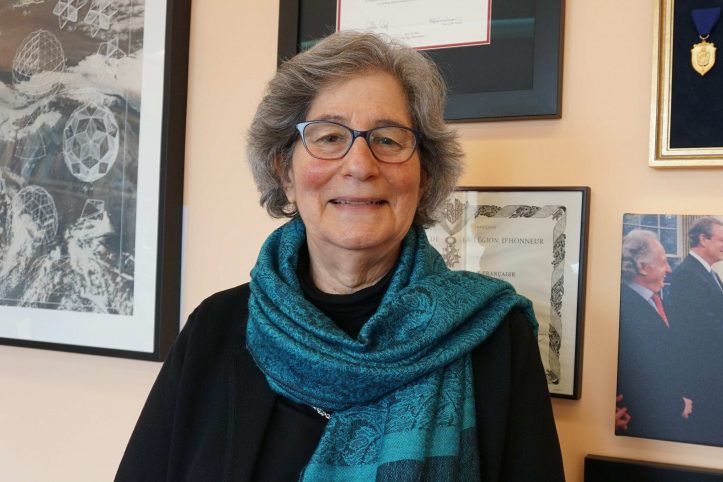
Tang Prize in Sustainable Development 2026 is awarded to Prof. Susan Solomon, for groundbreaking advances and leadership in atmospheric and climate sciences that shaped global policy for Sustainable Development.
Prof. Solomon is currently the Lee and Geraldine Martin Professor of Environmental Studies, Dept. of Earth, Atmospheric and Planetary Sciences, Massachusetts Institute of Technology (MIT). In MIT, she was the Founding Director of Environmental Solutions Initiative and Chair of the Program in Atmosphere, Ocean and Climate. She began her professional career as a Research Chemist at the National Oceanic and Atmospheric Administration (NOAA), where she worked from 1981 to 2011. During that period, she served as Senior Scientist in 1991-2011, and Program Leader of the Middle Atmosphere group (renamed to Chemistry and Climate Process group) from 1988 to 2011. She Joined the MIT in 2012.
Prof. Susan Solomon is world acclaimed for her seminal work on ozone layer depletion and climate change. In 1986 and 1987, Prof. Solomon, as Head project scientist of the U.S. National Ozone Expedition, McMurdo Station, led expeditions to Antarctica, where she collected the first direct measurements of reactive atmospheric chlorine compounds, which showed that CFCs were indeed the cause of the widening ozone hole there. Her findings provided one of the scientific cornerstones to shape the Montreal Protocol on Substances that Deplete the Ozone Layer, the landmark international agreement to phase out ozone-depleting substances, widely regarded as one of the most successful environmental treaties in history. Few scientists have had such a direct and lasting impact on a global treaty that safeguards the biosphere. In 2016, her research group at MIT identified the first encouraging signs of ozone recovery over Antarctica as a direct result of international cooperation to phase out the ozone-depleting chemicals— a landmark moment in sustainability science.
In 2009, Prof. Solomon published a groundbreaking study indicating that the climate impacts of CO2 emissions on surface temperature, rainfall and sea level are largely irreversible for more than 1000 years, even after CO2 emissions cease. It demonstrated the long-term harm to the environment caused by global warming. This paradigm-shifting finding crystallized the urgent need for early and sustained action on climate mitigation. It has had a lasting influence on both scientific understanding and international policy, reinforcing the link between science and sustainability. Prof. Solomon also showed how the thickness of the ozone layer in the southern hemisphere affects atmospheric flows and temperatures all the way down to ground level. For more than 40 years now, Prof. Solomon’s pioneering research on the impacts due to human-influenced trace gases in the Earth’s climate system have contributed enormously to our fundamental understanding of Earth’s chemistry-climate interactions. The heterogeneous chemical reactions proposed by Prof. Solomon play an integral part for all modeling efforts of the Earth’s stratospheric chemical composition. This work is now a classic in the environmental sciences.
From 2002 to 2008, Prof. Solomon co-led the production of the IPCC’s Fourth Assessment Report on the Physical Science of Climate Change, a comprehensive synthesis of scientific knowledge that became a cornerstone for global climate negotiations. She played a leading role in communicating to international policy-makers key scientific findings that helped inform the language of the 2015 Paris Agreement. Its message of “Warming of the climate system is unequivocal” and “Most of the observed increase in global average temperatures since the mid-20th century is very likely due to the observed increase in anthropogenic greenhouse gas concentrations” has set the fundamental tone of the world’s deliberations on adaptation, mitigation, vulnerability, and resilience. The Report, one of the most influential international expert assessments ever in the environmental sciences, was instrumental in securing broad public and political recognition of climate change as a critical issue. This comprehensive scientific report led to the IPCC winning the 2007 Nobel Peace Prize.
In 1994, Solomon Glacier (78°23'S, 162°30'E) and Solomon Saddle (78°23'S, 162°39'E) were named in honor of her leadership in Antarctic research —a rare and fitting tribute to a scientist whose life and work have been so closely tied to the polar regions and the planetary systems they influence. Beyond her scientific achievements, Prof. Solomon has also been an extraordinary ambassador for relating science to sustainability. She has delivered hundreds of lectures across the globe, briefed national governments and international bodies, and testified before the U.S. Congress on climate and atmospheric issues. Her book, “The Coldest March”, recounting Antarctic experiences, is a celebrated work that bridges science, history, and human endurance. Her most recent book “Solvable: How We Healed the Earth, and How We Can Do It Again” (2024), Prof. Solomon tells the remarkable story of how science, public policy, and international cooperation came together to solve the global crisis of ozone depletion—and offers a hopeful roadmap for tackling today’s environmental challenges.
Prof. Solomon’s career represents an exceptional blend of scientific discovery, societal impact, and moral leadership. Her groundbreaking work by combining Antarctic field research, modelling innovations, deep engagement with policy and the public has played a pivotal role in both the success of the Montreal Protocol and global climate negotiations. These contributions stand as landmark achievements in the pursuit of sustainability and serve as a reminder that scientific excellence can and must guide humanity toward a more sustainable future.
Prof. Solomon has won numerous honors for her works, including the US National Medal of Science and US National Academy of Sciences Award for Chemistry in Service to Society. Her science has changed the trajectory of the atmosphere, her leadership has shaped international treaties and policy, and her example has inspired colleagues and students worldwide. Prof. Solomon’s influence is not only significant in the contemporary period, but also has ramifications throughout the 21st century.
_final_1.jpg?1781230319299)
_final_2.jpg?1781230365640)
_final_3.jpg?1781230382210)
_final_4.jpg?1781230400332)
_final_5.jpg?1781230414008)
_final_6.jpg?1781230429786)
_final_7.jpg?1781230439060)
_final_8.jpg?1781230455260)