


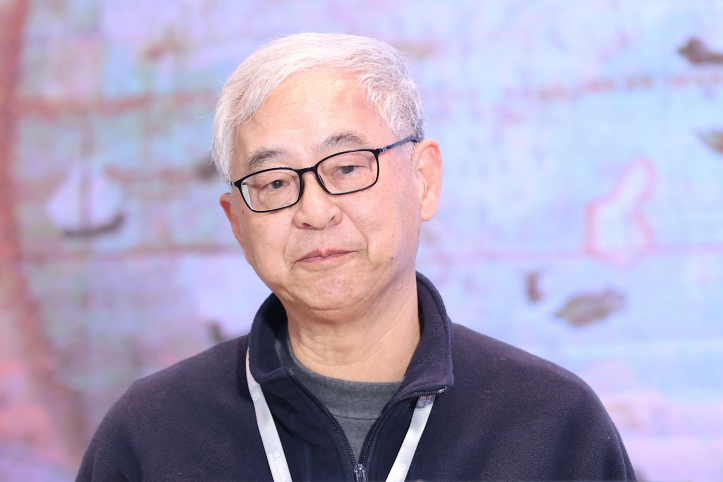
Since the 1980s, Ge Zhaoguang has published dozens of influential works. His scholarship is distinguished by both its breadth and depth, combining mastery of literature and history with a sustained engagement in academic inquiry and contemporary intellectual concerns. His research spans a wide range of fields, including the history of Chinese thought, religion, literature, and classical philology, while also maintaining close dialogue with broader intellectual trends, theoretical perspectives, and methodological debates in global Sinology. His work constitutes a profound response to international academic discourse and is marked by a compelling sense of inquiry and intellectual precision. Expansive in vision and penetrating in insight, he has made lasting contributions to the humanities.
Expanding the Horizons of the History of Chinese Thought
Professor Ge is especially renowned for his work in the history of thought, including Zhongguo Chan Sixiangshi: Cong Liu Shiji Dao Jiu Shiji [An Intellectual History of Chinese Chan: From the Sixth to the Ninth Century] (1995), An Intellectual History of China (2001; first published in Chinese in 1998), and Qufushi Ji Qita: Liuchao Suitang Daojiao De Sixiangshi Yanjiu [A History of Subjugation and Other Things: An Intellectual History of Daoism During the Six Dynasties and Sui-Tang Period] (2003). His An Intellectual History of China may be regarded as the defining achievement of the first half of his academic career. In this work, he redefined the scope of intellectual history through an entirely new approach, emphasizing the historical role of religious belief and advancing perspectives that differed from mainstream scholarship.
He argued that intellectual history should shift its focus from the “center” to the “margins,” from the “classics” to the “ordinary,” and from “elite thought” to the ideas and lived mental worlds of common people. These transformations were made possible in part by newly excavated archaeological materials and in part by changing theoretical perspectives in contemporary historiography. By incorporating everyday knowledge, popular beliefs, and cultural practices into the framework of intellectual history, he revealed the richness and diversity of Chinese thought while also reaching a broader readership. The influence of this work has extended far beyond the Chinese-speaking world: with the publication of Japanese, Korean, and English translations, it has also generated wide international discussion.
Particularly admired is the masterpiece’s sustained reflection on how intellectual history itself should be written. It distinguishes among the aims and methods of the history of thought, philosophy, and culture, while responding to challenges posed by such scholarly currents as the French Annales School and postmodernism. He carefully delineates the boundaries between intellectual history and the history of philosophy, redefining the essential concerns of intellectual history and expanding its scope beyond the originality of a small number of thinkers to encompass a broader “general intellectual history” that includes knowledge, thought, and belief. In doing so, he opened new possibilities for dialogue between intellectual history, cultural history, and social history.
Viewing China from Its Periphery
Historical discourse on “China” has been one of Professor Ge’s principal concerns in recent years. He has successively published a trilogy of studies on “China,” including Here in ‘China’ I Dwell: Reconstructing Historical Discourses of China for Our Time (2017; first published in Chinese in 2011), What is China? Territory, Ethnicity, Culture, and History (2018; first published in Chinese in 2014), and Lishi Zhongguo De Nei Yu Wai: Youguan “Zhongguo” Yu “Zhoubian” Gainian De Zaichengqing [The Inside and Outside of Historical China: A Reclarification of the Concept of “China” and its “Borders”] (2017), each examining conceptions of “China” in different historical periods. Drawing extensively on traditional textual and visual materials, he has also devoted considerable effort to the exploration, organization, and interpretation of Sinitic records of the diplomatic journey to China from Joseon, Vietnam, and other neighboring states.
Here in ‘China’ I Dwell demonstrates its strong emphasis on visual materials. By drawing on sources such as Shanhai Jing (The Classic of Mountains and Seas), Zhigong Tu (Illustrations of Tributary Peoples), historical maps, and travel accounts containing memories of foreign lands, he reconsiders and reimagines China from new perspectives. The work further explores the intertwined relationships among Asia, East Asia, and China, and examines the complex relations between China and its surrounding regions through discussions of the Western Regions, the Eastern Seas, and the emergence of studies on the “Manchus, Mongols, Hui, Tibetans, and Koreans.” Responding to major trends in Western scholarship on visual history, the book stands at the forefront of contemporary research.
Methodologically, Professor Ge consistently emphasizes “viewing China from its periphery.” His Xiangxiang Yiyu: Du Lichao Chaoxian Hanwen Yanxing Wenxian Zhaji [Imagining a Foreign Place: Notes on Korean Yi-dynasty Beijing Journals in Classical Chinese] is a representative example of examining China through sources and perspectives originating beyond its borders; in recent years, this research paradigm has become highly influential within Chinese academia.
Taken together, these works constitute both a systematic response to challenges posed by international scholarship framed through the perspective of the modern nation-state and a clarification of the historical evolution and multiple meanings of the concept of “China.” They illuminate the many dimensions of China’s territory, culture, thought, ethnicity, and politics, while placing particular emphasis on historical context. Thereby, they invite renewed reflection on the relationship between “historical China” and “contemporary China.”
Professor Ge has also responded to the long-standing emphasis within Taiwanese anthropology and historical anthropology on “viewing China from the periphery.” Through a comprehensive reexamination and reconstruction of the historical, cultural, and political foundations of “China,” his work has shaped new directions in historical research over the past decade and more.
Religious Studies in Historical Context
Professor Ge has conducted extensive and penetrating research on Buddhism, Daoism, Chinese popular religion, and even Christianity. Representative works include Chanzong Yu Zhongguo Wenhua [Chan Buddhism and Chinese Culture], Daojiao Yu Zhongguo Wenhua [Daoism and Chinese Culture], Zhongguo Chan Sixiangshi [An Intellectual History of Chinese Chan], and Qufushi Ji Qita [A History of Subjugation and Other Things]. Most of these studies were originally completed during the 1980s and 1990s and have since gone through multiple revised editions, exerting enormous influence within Chinese academia over the past four decades. As recently as 2025, he published Yuyin Bujue: Jiezhe Jiang Zongjiaoshi [Echoes That Never Fade: Continuing the Lecture on Religious History], testifying to the depth and continuity of his engagement with these subjects.
Written in an accessible style, Chanzong Yu Zhongguo Wenhua [Chan Buddhism and Chinese Culture] begins with the legendary tale of Bodhidharma crossing the Yangtze on a single reed and proceeds to offer a profound interpretation of why Southern Chan, represented by the Sixth Patriarch Huineng, ultimately surpassed Northern Chan and exerted such powerful appeal among the scholar-official class. Zhongguo Chan Sixiangshi [An Intellectual History of Chinese Chan], meanwhile, employs the categories of dharma masters, vinaya masters, and Chan masters to explain the historical transition of the Yogachara and Huayan schools from flourishing to decline, and their eventual giving way to Chan Buddhism, offering a penetrating analysis of the development of medieval Buddhism in China.
Qufushi Ji Qita [A History of Subjugation and Other Things] is undoubtedly the work most visibly shaped by post-structuralist thought. In it, Professor Ge posits that the rituals and techniques closely tied to everyday life in early Daoism—including shamans, fasting and offering rituals, talismans, and rites of passage—gradually disappeared from Daoist discourse and doctrine under the growing influence of Buddhism, largely because they failed to conform to the moral norms and “rational thought” promoted by ruling authorities. Likewise, the power and techniques through which early Daoism summoned spirits and deities, as well as its militarized organizations, were progressively erased because they posed serious challenges to state security and political order.
From Historical Consciousness to Humanistic and Artistic Interests
Trained in classical philology in the Department of Chinese at Peking University, Professor Ge has also made Chinese literature one of his major fields of research. His publications include The Magic Cube of Ancient Chinese Poetry: A Linguistic Perspective, Gu Shiwen Yaoji Xulu [Guide to Essential Texts of Classical Chinese Poetry and Prose], Tangshi Xuanzhu [Annotated Selections of Tang Poetry], Xiangxiangli De Shijie: Daojiao Yu Tangdai Wenxue [The World of Imagination: Daoism and Tang Dynasty Literature], and Zhongguo Zongjiao Yu Wenxue Lunji [The Studies in Chinese Religion and Literature], all of which offer in-depth studies of classical poetry and the relationship between religion and Chinese literature. In recent years, he has also published a series of studies in art history and visual history, examining maps, images of frontier peoples, religious imagery, and religious art from the perspective of the history of thought.
What makes Professor Ge outstandingly remarkable is his ability to move fluently across ancient and modern, Chinese and non-Chinese traditions alike, while transcending the conventional boundaries separating literature, history, philosophy, religion, and art. His scholarship ranges from the pre-Qin era to the twentieth century, always attentive to the larger trajectories of historical development and to the continuities and transformations linking past and present. Through his expansive vision, rigorous command of textual sources, and interdisciplinary methodology, he has fundamentally reshaped the historical studies of Chinese thought and religions, deepening scholarly understanding—both within China and internationally—of China, Chinese thought, and Chinese culture.
_final_1.jpg?1781235384323)
_final_2.jpg?1781235393034)
_final_3.jpg?1781235400700)
_final_4.jpg?1781235408368)
_final_5.jpg?1781235415542)
_final_6.jpg?1781235425566)
_final_7.jpg?1781235437055)
_final_8.jpg?1781235460146)